Your AI Is an Ivy League Grad With No Textbook
AI is the smartest hire you've ever made. It's also the most clueless about your business. Here's why your data isn't ready, what happens when you ignore that, and how to fix it.

TL;DR
Most enterprise data isn't AI-ready. Not because the data is bad, but because the context around it was never written down. Treating AI like a brilliant new hire who needs proper onboarding (not a magic oracle) is the mental model that separates companies shipping real AI value from those burning trust and budget.
There's no course book on your company
Here's the mental model that reframes the entire "AI readiness" conversation: treat AI like a fresh Ivy League grad you just hired. Smart. Capable. Motivated. But they know absolutely nothing about your business, your data, or your history.
Now imagine handing that new hire a Salesforce instance with five different ARR fields on the Account object, four of which are obsolete. No documentation. No one to ask. They'll pick a field, run with it, and deliver a beautifully formatted analysis built on the wrong number.
That's exactly what AI does. Except it does it faster, more confidently, and at scale.
The core problem isn't "bad data." It's that the knowledge required to use the data correctly lives in people's heads. How fields are computed. Which ones to use when. What the edge cases are. What changed after that migration three years ago that no one updated the wiki for.
This is institutional memory. And for most companies, it was never written down.
The older the company, the wider this gap. A five-year-old startup might have a manageable amount of tribal knowledge. A company operating at scale for 15 years has layers of undocumented decisions, deprecated fields, and "oh, just ask Sarah about that" shortcuts baked into every system.
Undocumented institutional knowledge is a terrible liability in the age of AI.
Being book smart can't help if there are no books.
What happens when you set smart people loose with no direction
When you unleash a brilliant new hire with zero context, one of two things happens: they sit idle (useless) or they start making confident moves based on incomplete information (dangerous). AI does the latter. Every time.
AI doesn't filter noise. It amplifies it.
Feed it a messy CRM and it will surface patterns in the mess. It will generate reports, build dashboards, and answer questions with total confidence, all grounded in data that anyone with institutional context would know to ignore.
I've seen this firsthand at HG Insights. If you want AI to connect to a database and produce useful SQL, you need to hand it a usable schema: what columns mean, how tables relate, and a set of curated queries that answer specific business questions. Expecting an LLM to produce good SQL for a business question with zero context is not going to work.
The obvious cost of this is bad decisions. Company velocity is the vector sum of every employee's velocity. If AI sends people in different directions with incorrect information, those vectors stop aligning and efficiency collapses.
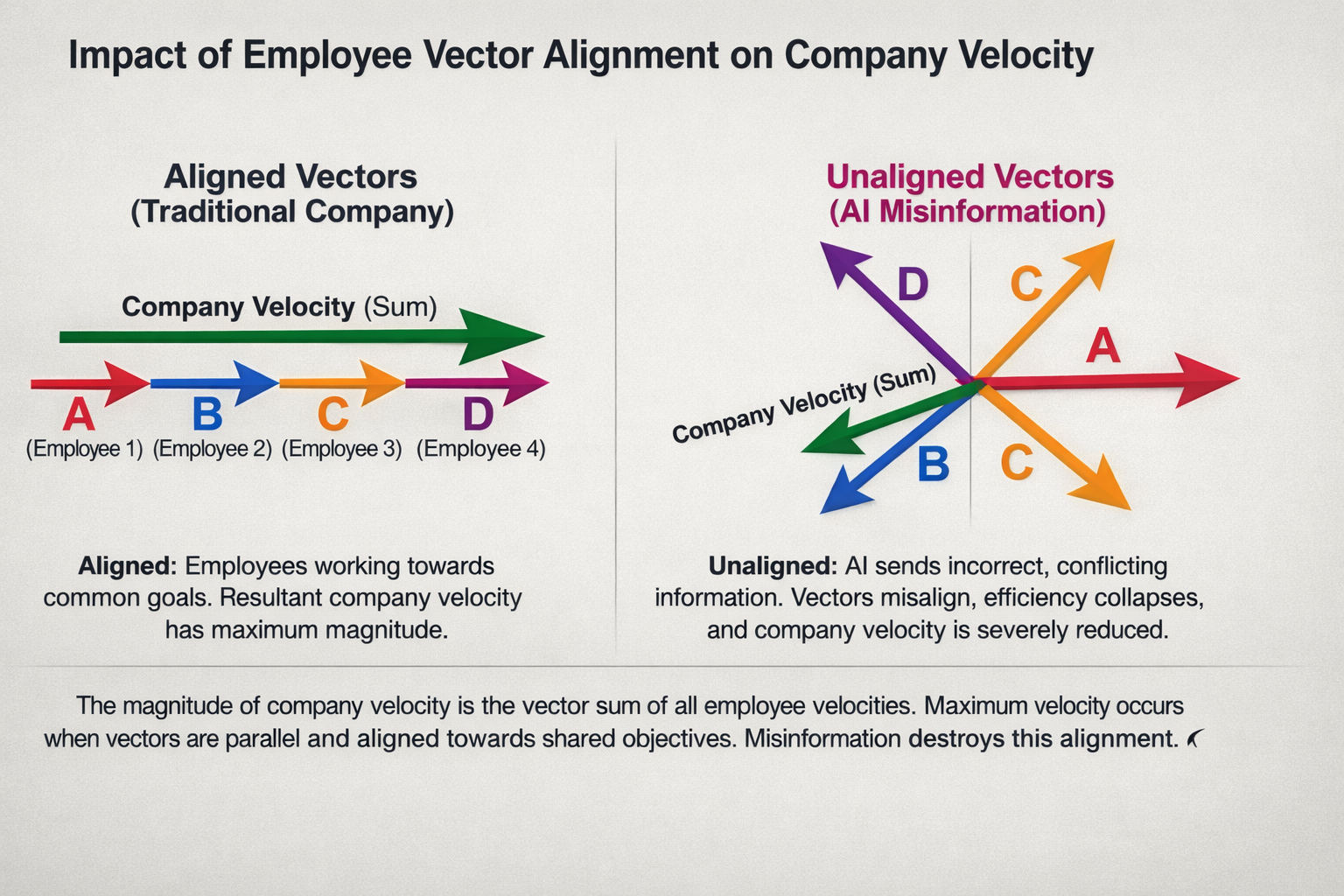
Company velocity
But the more dangerous cost is trust erosion. Once a team gets burned by a confidently wrong AI output, they stop using the system. Adoption stalls. And a company whose employees have given up on their AI tools will fall behind competitors who are running at full speed. This isn't a productivity hit. It's a competitive death spiral.
So what do you actually do about it?
There is no shortcut here. But there is a playbook.
Rank your data sources by expected value. Not all data needs to be AI-ready on day one. Start with the systems and fields that drive the highest-impact decisions. Your CRM account data, your product usage tables, your pipeline metrics. Prioritize ruthlessly.
Document the context, not just the schema. For each priority data source, write down what a smart outsider would need to know to use it correctly. Which fields are canonical. Which are deprecated. What business logic is embedded. How tables connect. This is the "textbook" your AI grad needs.
Use AI to accelerate the documentation. This is the one place where the chicken-and-egg problem actually resolves itself. Let AI interview your subject matter experts about each data source. Have it ask clarifying questions and draft the documentation. You can also pull from existing knowledge stores (Slack threads, Google Docs, SharePoint pages, Notion wikis) to crowdsource context.
Be ruthless about what you exclude. This is the trap for mature companies. If you've been operating at scale for 10+ years, there is a massive amount of outdated information in your systems. Old Slack threads, deprecated wikis, stale Confluence pages. Feeding all of that into AI won't provide more context. It will create confusion. Curation means deciding what not to include just as much as what to include.
The bigger picture
AI is redefining what leadership looks like. It requires being far more deliberate about the initiatives you undertake, because AI amplifies everything: good decisions, bad data, clear thinking, institutional chaos.
The companies that win with AI won't be the ones with the most sophisticated models. They'll be the ones that took the time to write the textbook.